
 Recommended Thru-hole Resistor types: Recommended Thru-hole Resistor types: |
| KOA Speer brand,
MF1/4 and CF1/4 Series - The MF1/4 series are truly excellent sounding 1% Nickel Chromium (NiChrome) metal film thru-hole resistors.
Although very affordable, we recommend them because of their clear sound
quality, which likely won't be beat at any price. For resistor values of 10 ohms or higher, use the KOA MF series (1% metal film). For values below 10 ohms, use the KOA CF series (5% carbon film) (see
bottom of this page for both MF and CF Series)
- The resistor values are color banded -
(see our Resistor
Color Code Chart). Some stocked at
www.mouser.com. |
| Vishay/Dale RN55
(1/4 watt) and RN60 or CMF60 (1/2 watt) - These NiChrome thru-hole resistors are used by many hi-end audio companies. They're very well built and offer excellent precision options, if
desired. They are brown color with conveniently stamped alphanumeric lettering for the resistor values. (Mouser keywords:
Vishay/Dale RN55D, RN60D, CMF55, CMF60) (available from www.mouser.com.) |
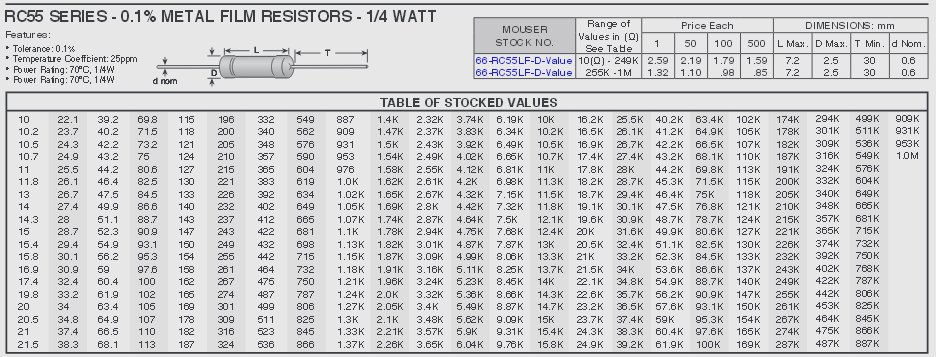
| IRC RC55 Series - The IRC RC55 series are 0.1% tolerance,1/4W, NiChrome thru-hole resistors. Their sonic qualities and clarity rival or surpass expensive, high-precision
Vishay bulk foil or even Caddock non-inductive resistors. They're a great choice for balanced line
stepped attenuators or any DIY application where you need/want real
precision. They are black color with white alphanumeric resistor value lettering.
(Mouser
keywords: IRC resistors)
(see
bottom of this page - available from www.mouser.com.) |
|
|
note: As a rule, stepped
attenuators using ANY type of resistors generally sound better than any
brand of carbon or conductive plastic potentiometers. Therefore, you
can even use Xicon
brand thru-hole resistors, which are 1% tolerance, Ruthenium metal
film, in 1/4W and 1/2W sizes. These are cheaply made and possibly the
least expensive thru-hole resistors you will find. Although their sound quality may be "mediocre", it is nevertheless generally OK and acceptable. They are light blue/green color with color banded resistor values.
(see our Resistor
Color Code Chart) They are readily available and well stocked at Mouser.com. (keywords: 273-1K-RC) (available from www.mouser.com.) |
|
How to Make Linear Taper Stepped Attenuators:
Note:
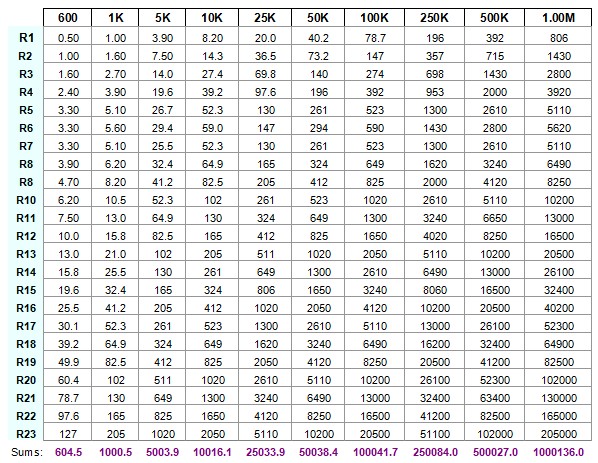
To make a series type linear taper stepped attenuator, divide your
chosen stepped attenuator value by the total number of switch positions
minus one (in our case 24 - 1 = 23 - or - 47 - 1 = 46). This resistor value is then
used for every resistor on your stepped attenuator. |
| Example: To make a
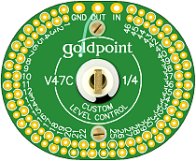
10K 24-position linear stepped attenuator using one of the V24C Custom switches,
divide 10,000 by 23, which is 434.78 ohms. Using off-the-shelf common resistor
values, use twenty-three 432 ohm resistors per channel (which makes a 9.936K
stepped attenuator.) Or use 442 ohms, which makes a 10.17K stepped attenuator.
(Fourty-six resistors are needed for a stereo unit.) |
| Example: To make a
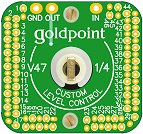
10K 47-position linear stepped attenuator using one of the V47C Custom switches,
divide 10,000 by 46, which is 217.39 ohms. Using off-the-shelf common resistor
values, use fourty-six 215 ohm resistors per channel (which makes a 9.89
stepped attenuator.) Or use 221 ohms, which makes a 10.17K stepped attenuator.
(Ninety-two resistors are needed for a stereo unit.) |
|
|